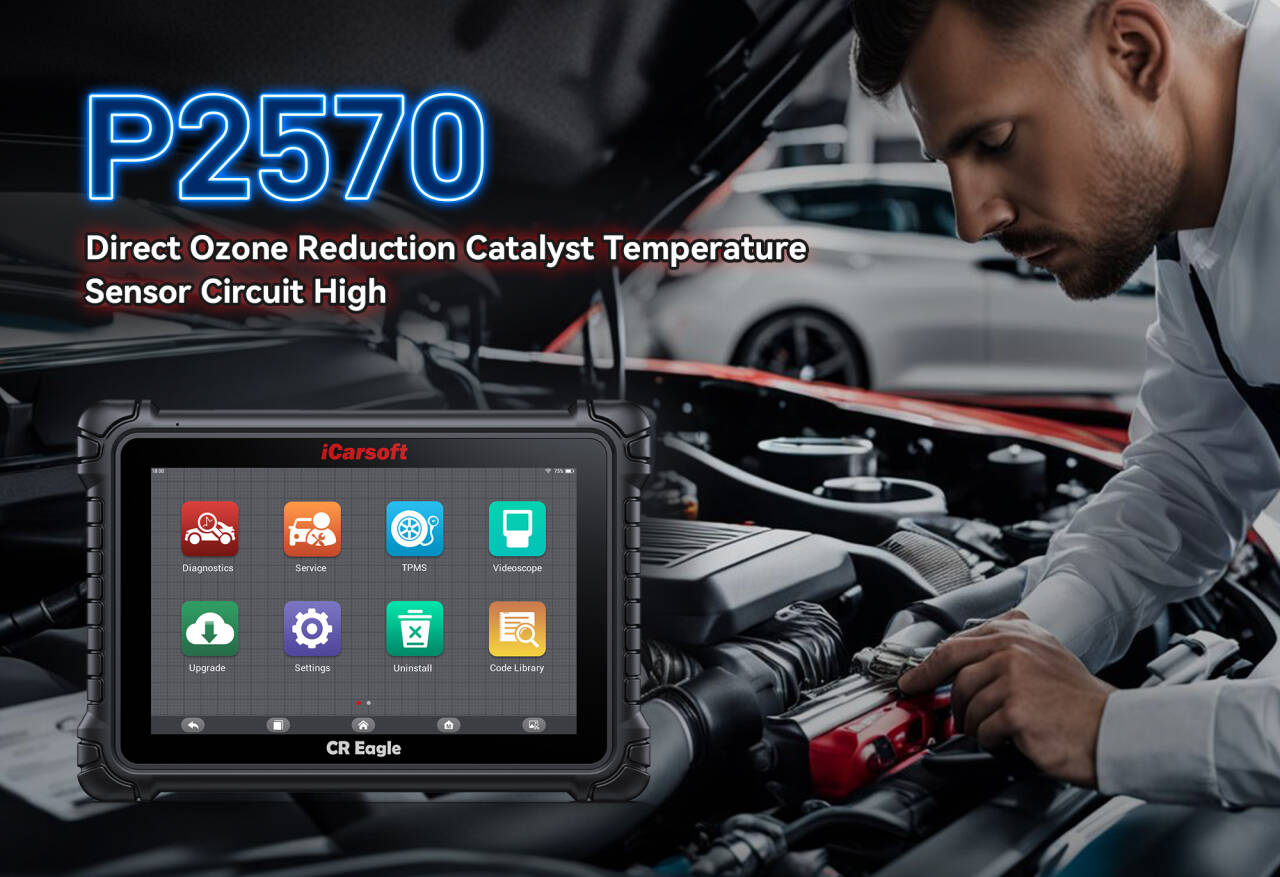
Fix P2570: Direct Ozone Reduction Catalyst Temperature Sensor Circuit High With iCarsoft CR Eagle
When your vehicle’s check engine light illuminates and your OBD-II scanner shows P2570, it signals a high circuit issue with the direct ozone reduction catalyst temperature sensor. This powertrain diagnostic trouble code (DTC) relates to your vehicle’s emission control system—ignoring it can trigger emission test failures, reduced fuel efficiency, and potential catalyst damage. In this guide, we’ll decode P2570 thoroughly and explain why the iCarsoft CR Eagle OBD2 Scanner is the best tool for diagnosing and clearing this fault.
What Is the P2570 Code Exactly?
The P2570 code is a generic OBD-II powertrain DTC, officially defined as Direct Ozone Reduction Catalyst Temperature Sensor Circuit High. It activates when the Engine Control Module (ECM) or Powertrain Control Module (PCM) detects an abnormally high voltage signal from the direct ozone reduction catalyst temperature sensor— a key component monitoring the catalyst’s operating temperature to ensure effective emission reduction.
This sensor provides real-time temperature data to the ECM, which adjusts fuel injection and ignition timing to maintain optimal catalyst performance. A high circuit signal (often above 4.5V) indicates a malfunction, disrupting emission control and potentially causing the catalyst to overheat or underperform. P2570 is common in modern gasoline vehicles equipped with ozone reduction catalyst systems, such as Honda, Toyota, and Hyundai models.
Common Symptoms of the P2570 Code
P2570 may not always cause severe drivability issues, but these warning signs indicate a need for prompt diagnosis:
-
Solid check engine light (MIL) or emission system warning light
-
Reduced fuel economy (8-12% drop due to improper timing)
-
Failed state or local emissions tests
-
Mild engine hesitation under heavy acceleration
-
Increased exhaust emissions (unusual odor from tailpipe)
-
Catalyst overheating (rare, but leads to costly replacement)
Top Causes of the P2570 Code
Diagnosing P2570 starts with identifying root causes of the high circuit signal—here are the most common culprits:
1. Faulty Direct Ozone Reduction Catalyst Temperature Sensor
Most common cause—internal sensor damage or wear leads to abnormal high voltage output.
2. Short-Circuited Wiring/Connectors
Wires touching the exhaust manifold or corroded connectors create a high circuit signal.
3. Damaged Sensor Connector
Bent pins, water intrusion, or corrosion disrupt signal transmission to the ECM.
4. ECM/PCM Malfunction
Rare, but a faulty module may misinterpret sensor signals as high circuit.
5. Exhaust Leaks Near Sensor
Extreme heat from leaks damages the sensor, causing erratic voltage.
6. Aftermarket Emission Modifications
Unapproved catalyst adjustments disrupt sensor operation.
Why iCarsoft CR Eagle Is Ideal for P2570 Diagnostics
Resolving P2570 requires a scanner that can read emission system data and test catalyst sensor circuits. The iCarsoft CR Eagle excels for DIYers and workshops, with features tailored to P2570 troubleshooting:
Full Emission System Compatibility
Works with 99% of 1996+ vehicles (Europe/Asia/America), including P2570-prone models like Honda Civic, Toyota Corolla, and Hyundai Elantra.
OE-Level Catalyst Sensor Data
Reads P2570 and related codes (P2571, P2572) + freeze-frame data (sensor voltage, engine temp) to pinpoint fault triggers.
Real-Time Voltage Monitoring
Displays live catalyst sensor voltage in 4-in-1 graph mode to verify high circuit issues (above 4.5V).
One-Click Code Clear & Verification
Erases P2570 post-repair and allows test drive rescans to confirm fault resolution.
ECM Reset & Sensor Calibration
Supports ECM reset and catalyst sensor calibration for accurate signal sync after replacement.
Wireless Convenience
Bluetooth/Wi-Fi VCI lets you monitor data while inspecting exhaust wiring/sensor.
Get the iCarsoft CR Eagle Now →
Step-by-Step P2570 Diagnosis with iCarsoft CR Eagle
Diagnose and fix P2570 efficiently with these steps:
Step 1: Connect the CR Eagle to Your Vehicle
Plug the CR Eagle’s VCI dongle into the OBD-II port and connect via Bluetooth/Wi-Fi.
Step 2: Run Auto Scan to Detect Fault Codes
Select your vehicle make/model, run an Auto Scan to detect P2570 and related emission codes.
Step 3: Monitor Live Catalyst Sensor Voltage
Check Live Data to monitor catalyst sensor voltage—confirm if it exceeds 4.5V (high circuit sign).
Step 4: Inspect Wiring/Connectors & Cross-Reference Data
Inspect sensor wiring/connectors for short circuits or corrosion, using freeze-frame data to cross-reference fault conditions.
Step 5: Repair/Replace Faulty Parts & Calibrate Sensor
Replace faulty sensor/wiring; perform ECM reset and sensor calibration via the scanner.
Step 6: Clear Code & Verify Fix
Clear P2570 with Quick Erase, take a 20-mile test drive, and rescan to ensure no recurrence.
Customer Reviews: iCarsoft CR Eagle for P2570
“My Civic threw P2570, and the dealer wanted $180 to diagnose. The CR Eagle read the code instantly, showed a high circuit in the ozone catalyst sensor, and let me calibrate the new one. Saved me over $400 total!”
— Jake W. (Honda Civic Owner)
“I’m not a mechanic, but the CR Eagle’s live voltage graph helped me confirm P2570 was from a shorted wire, not a bad sensor. Wireless feature let me check data while fixing the wiring—super easy to use.”
— Mia K. (DIY Car Hobbyist)
“We rely on the CR Eagle for all P2570 jobs. It’s compatible with every make we service and the sensor calibration function fixes most high circuit issues fast. Way better value than dealer tools.”
— Mark’s Auto Repair
FAQs About the P2570 Code
1. How serious is the P2570 code?
It’s moderately serious. It won’t disable your vehicle immediately, but it causes emission test failures and can damage the ozone reduction catalyst—costly to replace—if ignored.
2. Can I drive with P2570?
Short trips are safe, but avoid long drives. Persistent high circuit signals may overheat the catalyst, leading to expensive repairs.
3. How much does it cost to fix P2570?
Costs range from $120 (DIY sensor/wiring repair) to $700 (dealer catalyst replacement + labor). The CR Eagle helps avoid misdiagnosing expensive parts.
4. Will P2570 clear on its own?
No—P2570 is a persistent fault caused by physical or electronic issues that require repair before the code can be permanently cleared.
5. Does iCarsoft CR Eagle work for all P2570-triggered vehicles?
Yes—it’s compatible with 10,000+ OBD-I/OBD-II models, including gasoline vehicles with direct ozone reduction catalyst systems.
6. Can the CR Eagle calibrate the throttle body for P2570?
Absolutely—its built-in catalyst sensor calibration function ensures the new or repaired sensor syncs correctly with the ECM for accurate voltage readings.
7. What other codes are related to P2570?
Related codes include P2571 (circuit low), P2572 (circuit intermittent), and P0420 (catalyst efficiency below threshold).
8. Can I fix P2570 myself?
Yes—with the iCarsoft CR Eagle, basic tools, and mechanical know-how. Seek a mechanic only if catalyst replacement is needed.
Final Thoughts: Don’t Ignore P2570
The P2570 code is a key warning of direct ozone reduction catalyst sensor issues that impact emissions and catalyst health. The iCarsoft CR Eagle simplifies diagnosis, cuts repair costs, and ensures accurate fixes—making it a must-have for car owners dealing with P2570. Invest in this tool to keep your vehicle’s emission system in top shape.
Buy iCarsoft CR Eagle Today →
Disclaimer: This guide is for informational purposes only. Always consult your vehicle’s owner’s manual or a certified mechanic before major repairs. iCarsoft is not responsible for damage from improper tool use.