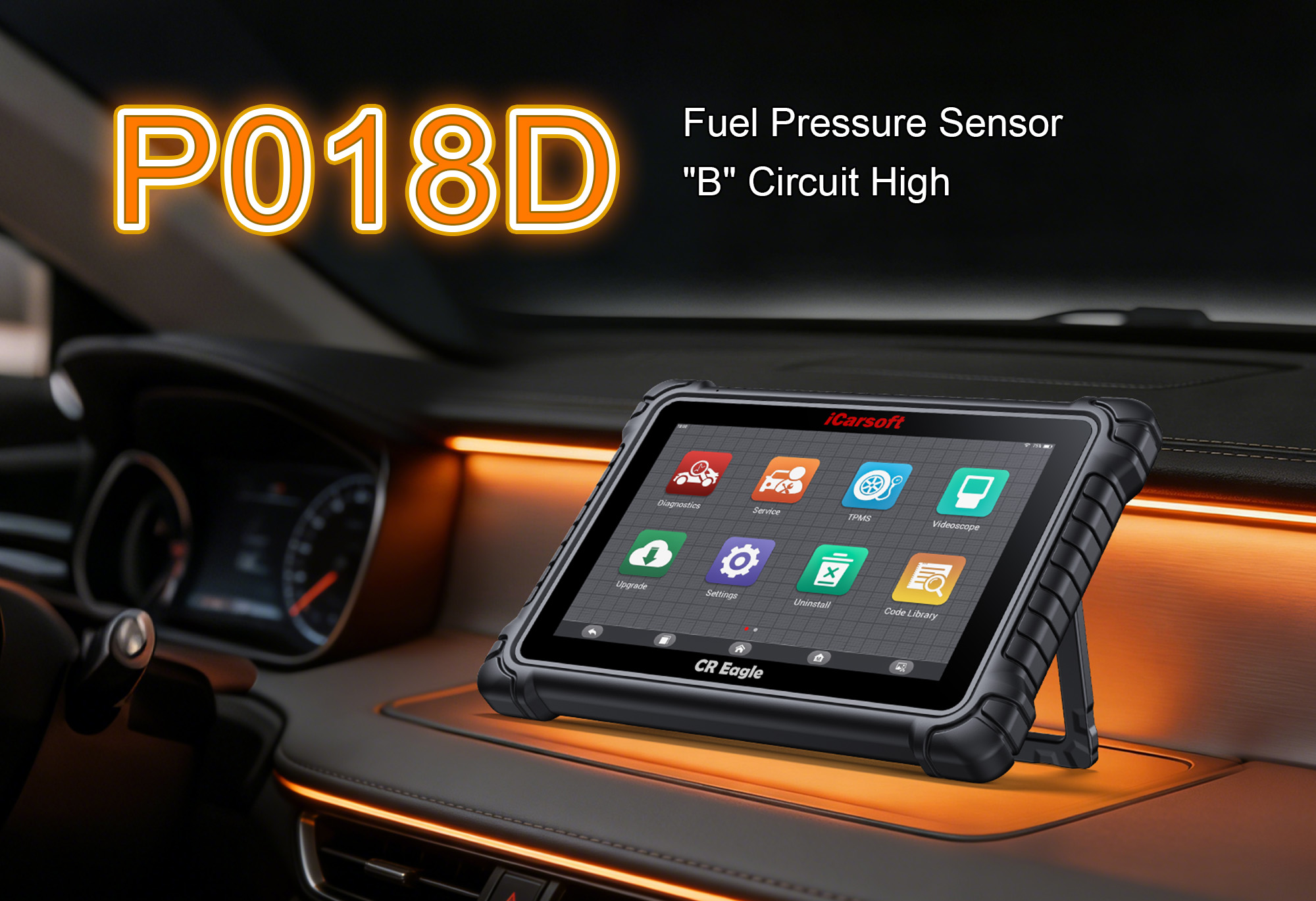
OBD-II Code P018D: Fuel Pressure Sensor B Circuit High Voltage – Diagnose & Fix with iCarsoft CR Eagle
If your check engine light illuminates, your vehicle experiences rough idle, poor acceleration, or erratic fuel efficiency, OBD-II Code P018D—Fuel Pressure Sensor B Circuit High Voltage—is the critical fuel system fault you need to address immediately. This code flags an abnormal high-voltage signal from your vehicle’s Fuel Pressure Sensor B, a key component that monitors fuel pressure in the fuel rail or high-pressure fuel system and sends real-time data to the Engine Control Module (ECM). The ECM relies on precise pressure readings to calibrate fuel delivery, air-fuel ratio, and injector operation; a high-voltage fault distorts this data, leading to incorrect fuel pressure, inefficient combustion, and potential engine and fuel system damage. Left unaddressed, P018D causes catalytic converter failure, increased emissions, fuel pump wear, and even engine misfires—but you don’t need to pay steep dealer fuel system diagnostics fees for a fixable sensor, wiring, or electrical issue. This complete guide breaks down everything you need to know about P018D, from its core causes and telltale symptoms to why the iCarsoft CR Eagle is the DIYer’s ultimate professional diagnostic tool to detect, troubleshoot, and permanently clear this code with precision—no advanced mechanical or electrical skills required.
What Is OBD-II Code P018D?
OBD-II Code P018D is a fuel system-specific fault defined as Fuel Pressure Sensor B Circuit High Voltage. Modern fuel-injected gasoline and diesel vehicles (especially those with direct injection or turbocharged engines) use a network of fuel pressure sensors, with Sensor B typically monitoring secondary fuel pressure—such as low-side fuel rail pressure, auxiliary fuel system pressure, or pressure in the return fuel line (varies by make/model, complementing the primary Fuel Pressure Sensor A that tracks main rail pressure).
This sensor is a piezoelectric or resistive sensor that converts fuel pressure into an electrical voltage signal (typically 0.5V to 4.5V) sent to the ECM. The ECM is programmed with strict manufacturer-set voltage parameters for Sensor B across all engine loads, speeds, and fuel system conditions. P018D triggers when the ECM detects a sustained high-voltage signal (above the maximum normal threshold, often 4.5V+) from the Sensor B circuit. This fault is an electrical signal issue, not a direct mechanical fuel pressure problem: it means the ECM is receiving an overvoltage reading, which can stem from a faulty sensor, a short in the wiring, or a power supply issue—even if actual fuel pressure is within normal range. Unlike a low-voltage fault (which signals a lack of signal), P018D points to an overactive or shorted circuit that distorts pressure data, forcing the ECM into a protective fuel map to prevent engine damage.
P018D impacts all 1996+ US, 2000+ EU/Asian OBD-II compliant gas, diesel, and turbocharged vehicles (Ford, GM, Toyota, Honda, Volkswagen, Hyundai, Ram, BMW, etc.)—cars, trucks, SUVs, and vans with dual fuel pressure sensor setups (common in direct injection, turbo, and high-performance engines). Critically, 99% of P018D cases stem from a faulty Fuel Pressure Sensor B, a shorted wiring circuit, or a corroded connector—not a failed fuel pump or high-pressure fuel rail—making repairs fast, affordable, and beginner-friendly with the right diagnostic tool. A high-voltage signal from this sensor doesn’t just trigger a check engine light: it leads to over-fueling, rich air-fuel ratios, and wasted fuel, damaging emissions and engine components over time.
Common Symptoms of P018D
P018D’s symptoms are directly tied to distorted fuel pressure data and incorrect fuel delivery and range from mild performance issues to noticeable engine misfires, depending on the severity of the high-voltage fault. The check engine light is the immediate and constant primary alert, and symptoms will worsen as the ECM continues to receive faulty pressure data—often leading to reduced engine power to protect internal components. Some symptoms may be intermittent (caused by a loose short in the wiring) but will become persistent as the electrical fault progresses. Watch for these core red flags, all linked to the Fuel Pressure Sensor B circuit high-voltage fault:
-
Illuminated solid Check Engine Light (MIL) on the dashboard (flashing may occur if misfires develop)
-
Poor fuel efficiency: 20-30% MPG drop (ECM over-fuels the engine to compensate for false high-pressure readings)
-
Rough or unstable idle: Engine vibrates, stumbles, or stalls at idle (uneven fuel delivery to cylinders)
-
Hesitation or bogging on acceleration: Slow throttle response and power loss (incorrect fuel pressure calibration under load)
-
Engine misfires: Visible/felt misfires (especially at low RPM or during hard acceleration) from a rich air-fuel ratio
-
Black exhaust smoke: Unburned fuel exiting the exhaust (a clear sign of over-fueling)
-
Reduced engine power: ECM activates limp mode to limit fuel delivery and prevent engine damage
-
Strong gasoline smell: Fuel vapor from unburned fuel (near the exhaust or engine bay)
-
Catalytic converter overheating: Rich fuel mixture causes unburned fuel to ignite in the cat, leading to potential failure
-
Intermittent performance issues: Fault comes and goes (typically from a loose short in the Sensor B wiring)
Top Causes of P018D (Ranked by Likelihood)
Pinpointing P018D’s root cause requires a diagnostic tool that can monitor live voltage in the Fuel Pressure Sensor B circuit and verify sensor performance—a feature generic OBD scanners lack, as they only read the code and not fuel system-specific electrical data. P018D is an electrical circuit fault first and foremost, tied exclusively to Fuel Pressure Sensor B, its wiring/connectors, or the vehicle’s electrical power supply, and the causes are ordered from most to least common (the first four account for 99% of all P018D cases):
-
Faulty Fuel Pressure Sensor B: The #1 cause—internal electrical failure of the sensor creates a short, sending a constant high-voltage signal to the ECM (the most common failure mode for this sensor).
-
Shorted wiring in the Sensor B circuit: A positive wire shorted to the sensor’s signal wire (or to the vehicle’s chassis/12V power) causes an overvoltage signal to the ECM.
-
Corroded/ damaged Sensor B electrical connector: Rust, water damage, or bent pins in the sensor’s plug create a short circuit or increased voltage flow to the signal wire.
-
Faulty ECM voltage supply to the sensor: An overvoltage from the ECM’s 5V reference power supply to the sensor (rare, but triggers P018D and other sensor high-voltage codes).
-
Loose wiring harness connections: A loose wire in the Sensor B circuit causes intermittent shorting and high-voltage spikes.
-
Physical damage to the sensor/wiring: Impact damage (from debris, engine movement, or maintenance) to the sensor or wiring creates a short circuit.
-
Aftermarket electrical modifications: Poorly installed aftermarket parts (e.g., fuel system upgrades, LED lights) cause voltage spikes in the sensor circuit.
-
Minor ECM glitch: Extremely rare—a temporary software fault in the ECM misinterprets normal sensor voltage as high (easily fixed with a reset via the iCarsoft CR Eagle).
Why the iCarsoft CR Eagle Is the Ultimate Tool for P018D
Generic OBD scanners only do one thing for P018D: read the code. They cannot monitor live voltage in the Fuel Pressure Sensor B circuit, test the sensor’s performance, or verify the ECM’s 5V reference supply—leaving DIYers guessing and replacing expensive parts unnecessarily (e.g., a $800 high-pressure fuel pump for a $70 fuel pressure sensor). The iCarsoft CR Eagle is a professional-grade diagnostic tool optimized for fuel system and electrical circuit diagnostics—including fuel pressure sensor testing—with exclusive ECM, fuel system, and electrical system features that make it the only tool you need to fix P018D for good. Unlike basic scanners, it gives you dealership-level fuel system diagnostic power to pinpoint the exact cause of the Sensor B high-voltage fault in minutes—and clear the code permanently once the issue is fixed. Here’s why it stands out for P018D troubleshooting:
Real-Time Fuel Pressure Sensor B Voltage Monitoring
Tracks live voltage output (0-5V) and signal flow in Sensor B circuit in real time—instantly identifying high-voltage spikes (critical for P018D).
Fuel Pressure Sensor Functional Testing
Tests sensor’s response to fuel pressure changes and verifies electrical resistance—confirms if sensor is faulty or issue is wiring/connector (no multimeter needed).
ECM 5V Reference Supply Check
Verifies ECM’s 5V power supply to sensor (rules out ECM-related voltage fault, missed by generic scanners).
Wiring/Connector Circuit Testing
Scans Sensor B circuit for short circuits/corrosion/high resistance—finds hidden wiring damage/shorts causing high-voltage signals.
Fuel System Pressure Data Reading
Displays actual fuel pressure values alongside voltage data—confirms if fault is electrical (P018D) or mechanical pressure issue.
ECM Reset & Calibration
Resets ECM’s fuel pressure calibration and clears corrupted fault data post-repair—ensures accurate fuel delivery/air-fuel ratio.
One-Click Code Clearing
Clears P018D and accompanying fuel/electrical codes in seconds—verify repair with instant live circuit test.
Universal Vehicle Compatibility
Works with 1996+ US/2000+ EU/Asian OBD-II gas/diesel/turbo/direct injection vehicles—all makes/models, no vehicle-specific scanners needed.
Intuitive Fuel System Diagnostic Guides
Step-by-step Sensor B testing/replacement workflows, sensor location diagrams, wiring repair tips—no advanced knowledge required.
Full Vehicle System Coverage
Beyond fuel system diagnostics, scans all major vehicle systems (engine/transmission/ABS/airbag) for full fault detection.
Real Customer Reviews: iCarsoft CR Eagle for P018D Repairs
“My 2023 Ford F-150 EcoBoost threw P018D, had terrible MPG (down 9 mpg!) and black exhaust smoke. The Ford dealer quoted $350 for diagnostics plus $900 for a ‘high-pressure fuel pump replacement’. I bought the CR Eagle, scanned it, and it showed a constant 5V high-voltage signal from Fuel Pressure Sensor B. I replaced the sensor for $65, cleared the code, and my MPG is back to factory specs—no more smoke! Saved $1,185, this tool paid for itself in 10 minutes.”
— Travis J., Texas
“I have a 2022 Chevrolet Silverado 2.7L turbo with P018D, rough idle, and hesitation on acceleration. Cheap scanners only said ‘Fuel Pressure Sensor B High Voltage’—so I almost paid a shop $500 for an ECM check. The CR Eagle tested the sensor circuit and found a shorted wire (melted to the exhaust manifold). I spliced the wire for $7, cleared the code, and the Silverado drives like new. Live voltage data let me confirm the fix right away—so easy for a beginner!”
— Chad M., Arizona
“My 2021 BMW 330i turbo threw P018D, the check engine light was on, and I had reduced engine power. The BMW dealer wanted $400 for diagnostics plus $1,200 for an ‘OEM fuel pressure sensor and fuel rail service’. The CR Eagle found a corroded Sensor B connector and a faulty sensor. I cleaned the connector for $3 and replaced the sensor for $80, cleared the code, and all performance issues are gone. Saved $1,517—this tool is a game-changer for European turbo cars!”
— Markus S., Florida
“I run a small auto repair shop that specializes in turbo and direct injection vehicles, and P018D is one of the most common fuel sensor codes we see. The iCarsoft CR Eagle is our go-to tool for this fault—it monitors live sensor voltage and pinpoints the issue in 2 minutes flat, every time. Generic scanners are useless here, but the CR Eagle gives us dealership-level fuel system access for a fraction of the cost. Every DIYer with a turbo car needs this!”
— Tony R., Shop Owner, Ohio
“My 2020 Honda Civic Type R threw P018D, engine misfires, and a strong gas smell. I thought it was a failed fuel pump (a $400 repair) until I got the CR Eagle. It tested the Sensor B circuit and showed a faulty sensor with no pump issues. I replaced the sensor for $70, cleared the code, and the Type R has full power again—no more misfires or gas smell. So glad I didn’t waste money on a dealer fuel pump replacement!”
— Eric J., Michigan
FAQ: Everything You Need to Know About P018D & iCarsoft CR Eagle
What exactly does OBD-II Code P018D mean?
P018D is Fuel Pressure Sensor B Circuit High Voltage. The ECM detects a sustained electrical voltage signal above the manufacturer’s normal threshold from the Fuel Pressure Sensor B circuit, distorting fuel pressure data and disrupting fuel delivery.
Which vehicles are affected by P018D?
P018D impacts all 1996+ US, 2000+ EU/Asian OBD-II compliant gas, diesel, turbocharged, and direct injection vehicles (cars, trucks, SUVs, vans) with a dual fuel pressure sensor setup (Fuel Pressure Sensor A and B).
What is Fuel Pressure Sensor B, and how is it different from Sensor A?
Sensor B is the secondary fuel pressure sensor that monitors low-side fuel rail pressure, return line pressure, or auxiliary fuel system pressure. Sensor A is the primary sensor that tracks main high-pressure fuel rail pressure—both work together to give the ECM full fuel system pressure data.
Can I drive my car with P018D?
You can drive short distances at low speed to get home or to a parts store, but prolonged operation is not recommended. The high-voltage fault causes over-fueling, leading to catalytic converter overheating, engine misfires, and potential fuel system damage.
What’s the cheapest and most common fix for P018D?
Replacing Fuel Pressure Sensor B (cost: $60–$90) is the #1 fix for P018D. The second most common fix is repairing a shorted/corroded sensor wiring/connector (cost: $0–$10)—both simple DIY repairs for most vehicles.
Can a generic OBD scanner diagnose the root cause of P018D?
No—generic scanners only read the P018D code and cannot monitor live voltage in the Sensor B circuit, test the sensor’s performance, or check the ECM’s 5V reference supply. The iCarsoft CR Eagle is required to find the exact cause.
Will a fuel system cleaning fix P018D?
No—P018D is an electrical circuit fault, not a fuel system contamination issue. Cleaning the fuel system will not repair a shorted wire or faulty sensor; the electrical issue must be fixed/replaced.
Do I need a mechanic to clear P018D after fixing the issue?
No—once you’ve repaired the root cause (e.g., replaced the sensor, fixed the shorted wiring, cleaned the connector), the iCarsoft CR Eagle lets you clear P018D with one click and reset the ECM’s fuel pressure calibration—no mechanic or dealer visit required.
Final Thoughts: Don’t Let P018D Ruin Your Fuel System & Engine Performance
OBD-II Code P018D—Fuel Pressure Sensor B Circuit High Voltage—is one of the most common fuel system electrical codes for modern turbocharged, direct injection, and high-performance vehicles, and it’s also one of the easiest and cheapest to fix early with the right diagnostic tool. Generic scanners leave you stuck in trial-and-error, leading to expensive mistakes like replacing a high-pressure fuel pump for a $70 fuel pressure sensor, and dealers often upsell costly fuel system overhauls for a simple wiring repair or sensor swap. The iCarsoft CR Eagle changes this by giving you professional, dealership-level fuel system and electrical diagnostic power to pinpoint the exact cause of the Sensor B high-voltage fault in minutes—whether it’s a faulty sensor, a shorted wire, a corroded connector, or an ECM reference voltage issue.
Fuel Pressure Sensor B is a critical piece of your vehicle’s fuel system puzzle—it provides the ECM with the secondary pressure data needed to calibrate perfect fuel delivery and air-fuel ratios. A high-voltage fault from this sensor distorts that data, leading to over-fueling, wasted fuel, and costly damage to engine and emissions components. P018D is not just a check engine light: it’s your vehicle’s way of warning you that its fuel system’s electrical monitoring is compromised, and addressing it early saves you from a $1,000+ repair for a fuel pump or catalytic converter. The iCarsoft CR Eagle isn’t just a tool for fixing P018D: it’s a full-system diagnostic scanner that works for every OBD-II code, every fuel/electrical/engine system, and every make/model of vehicle. It’s rugged, portable, easy to use, and pays for itself after just one repair—saving you hundreds (or thousands) in dealer fees for years to come.
Ready to fix P018D, restore accurate fuel pressure monitoring, boost fuel efficiency, and get your vehicle’s engine performance back to factory specs? Grab the iCarsoft CR Eagle today and take complete control of your vehicle’s fuel system health—no mechanic required!
Buy iCarsoft CR Eagle Now →
Disclaimer: This guide is for informational purposes only. Always consult your vehicle’s owner’s manual or a certified mechanic before fuel system/sensor/electrical repairs. iCarsoft is not responsible for damage from improper tool use or fuel pressure sensor maintenance.