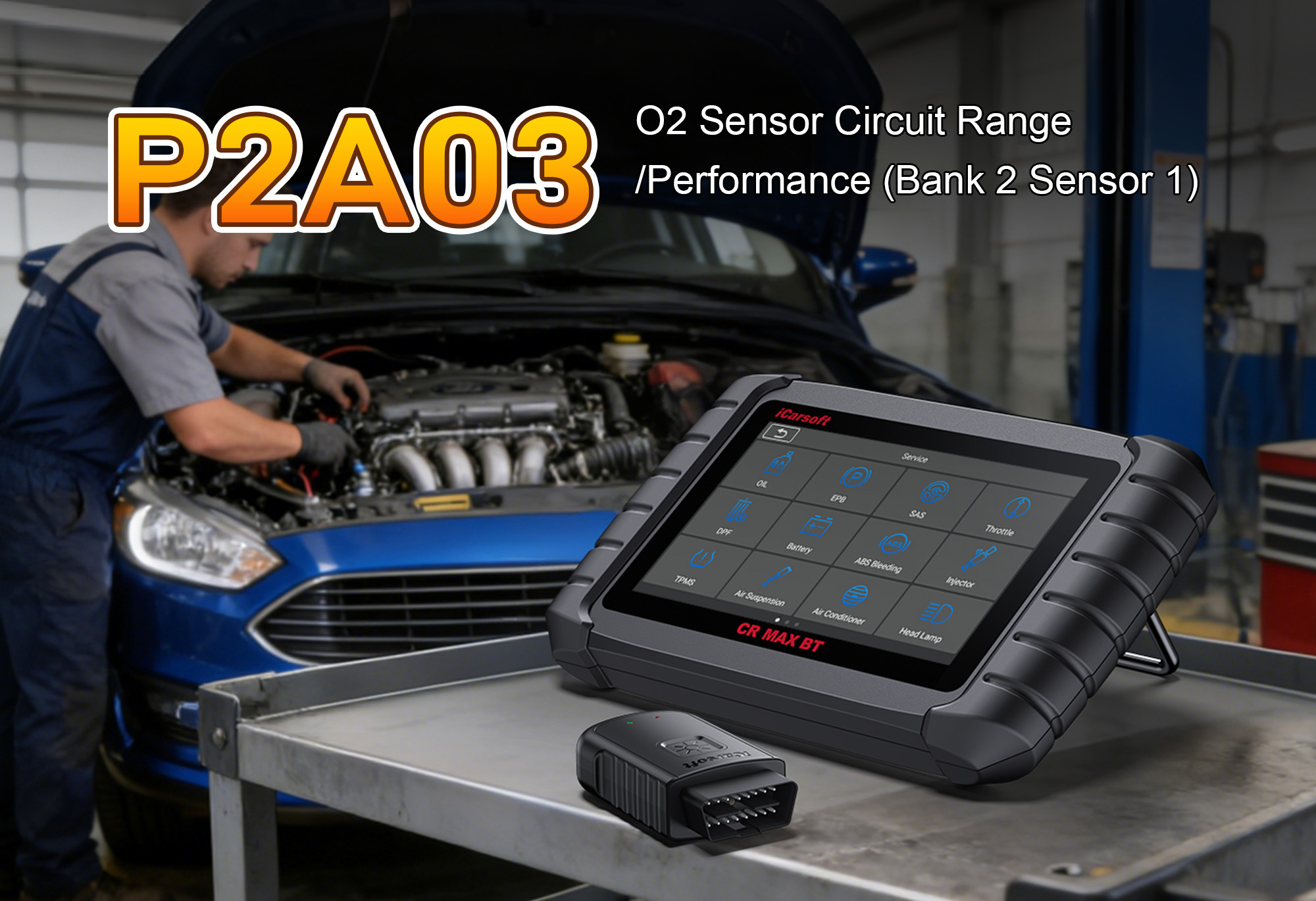
OBD-II Code P2A03: Bank 2 Sensor 1 O2 Sensor Performance Issue – Fix with iCarsoft CR MAX BT
If your check engine light illuminates, your fuel efficiency plummets, or your engine idles roughly with OBD-II Code P2A03—a Bank 2, Sensor 1 upstream oxygen (O2) sensor performance issue—you’re dealing with a critical fault in your vehicle’s fuel and emissions control system. The upstream O2 sensor is the ECM’s “eyes” for measuring exhaust oxygen levels, and a performance failure means your Engine Control Module (ECM) can no longer fine-tune the air-fuel mixture for optimal combustion. Left unaddressed, P2A03 causes increased fuel consumption, poor engine performance, failed emissions tests, and even catalytic converter damage over time. But you don’t need to pay steep dealer diagnostic fees for a fixable O2 sensor issue: this guide breaks down everything you need to know about P2A03, plus why the iCarsoft CR MAX BT diagnostic tool is the DIYer’s ultimate solution to detect, troubleshoot, and clear this error code with professional precision—no advanced mechanical skills required.
What Is OBD-II Code P2A03?
OBD-II codes are the ECM’s universal alert system for powertrain and emissions malfunctions, and P2A03 specifically identifies a performance fault in the Bank 2, Sensor 1 upstream oxygen sensor—a core component of modern fuel management systems that directly impacts combustion efficiency and emissions. Here’s a jargon-free breakdown for all drivers:
-
Bank 2: The cylinder bank that does not contain the number 1 cylinder (inline engines have only one bank and will never throw P2A03; this code is exclusive to V-config engines—V6, V8, V10—e.g., Toyota, Ford, BMW, Chevrolet models).
-
Sensor 1 (Upstream): The O2 sensor mounted before the catalytic converter on Bank 2’s exhaust manifold. It’s the primary sensor for measuring exhaust oxygen content, sending real-time voltage signals to the ECM to adjust the air-fuel mixture (Sensor 2 is the downstream sensor after the catalytic converter, for monitoring converter efficiency).
-
Performance Issue: The sensor’s voltage signals fall outside the manufacturer’s pre-set normal range (0.1-0.9V for traditional O2 sensors; steady voltage for wideband sensors), or the signal is slow to respond to changes in exhaust oxygen levels. This means the ECM can no longer accurately calibrate the air-fuel mixture, leading to rich or lean combustion.
-
P2A03 is one of the most common O2 sensor-related fault codes, appearing on all 1996+ US, 2000+ EU/Asian OBD-II compliant V-config gas and hybrid vehicles. It’s a sensor or electrical fault first—rarely a sign of major engine damage—and repairs are affordable and straightforward with the right diagnostic tool.
Common Symptoms of P2A03
P2A03’s symptoms are directly tied to poor air-fuel mixture calibration, with the check engine light as the first and most consistent warning. You’ll notice a mix of performance and fuel efficiency issues, which worsen as the sensor’s performance degrades:
-
Illuminated solid Check Engine Light (MIL) on the dashboard (the primary indicator)
-
Significant drop in fuel efficiency (the most noticeable symptom—ECM overfues or underfuels the engine)
-
Rough engine idling or intermittent misfiring (unbalanced air-fuel mixture disrupts combustion)
-
Sluggish acceleration and reduced engine power (lean/rich mixture robs the engine of power)
-
Strong fuel or rotten egg exhaust fumes (rich mixture causes unburned fuel; rotten eggs signal catalytic converter stress)
-
Failed state/local emissions tests (combustion inefficiency skews exhaust pollutant levels)
-
Engine hesitation or stuttering when pressing the gas pedal (especially at low/mid RPMs)
-
Increased engine carbon buildup (from prolonged rich/lean combustion)
Top Causes of P2A03
Pinpointing P2A03’s root cause is simple with the right diagnostic tool, and 95% of cases are caused by the O2 sensor itself or minor electrical issues (no need for expensive engine repairs). The most common triggers, ordered by likelihood, are:
-
Faulty Bank 2, Sensor 1 O2 sensor: Internal wear or failure of the sensor (the #1 cause)—the sensing element or heating element dies, leading to erratic or non-responsive voltage signals.
-
Corroded/loose sensor wiring/connector: Rust, dirt, or loose pins in the sensor’s electrical connector disrupt voltage flow between the sensor and ECM, causing signal performance issues.
-
Sensor contamination: Oil, carbon, or fuel residue coats the sensor’s sensing element (from a leaking valve cover, bad fuel injector, or dirty air filter), blocking it from measuring oxygen levels accurately.
-
Exhaust leak near the sensor: A cracked exhaust manifold or loose gasket on Bank 2 lets fresh air into the exhaust, skewing the sensor’s oxygen readings and triggering a performance fault.
-
Faulty O2 sensor heating element: The heating element warms the sensor to operating temperature quickly; a failure causes slow signal response, which the ECM registers as a performance issue.
-
Clogged air filter or dirty mass air flow (MAF) sensor: Restricted air flow leads to a rich air-fuel mixture, forcing the O2 sensor to work outside its normal range.
-
Fuel system issues: Leaking fuel injectors or a faulty fuel pressure regulator create a rich mixture, overwhelming the O2 sensor’s ability to adjust.
-
ECM signal interpretation fault (extremely rare): The ECM itself fails to read valid sensor signals—only after all other sensor/electrical issues are ruled out.
Why the iCarsoft CR MAX BT Is Ideal for P2A03
Generic OBD scanners only read the P2A03 code—they cannot monitor the O2 sensor’s real-time voltage signals, test its heating element, or distinguish between a faulty sensor and a corroded connector. This leaves many DIYers guessing and replacing parts unnecessarily (e.g., a catalytic converter when the real issue is a $50 O2 sensor). The iCarsoft CR MAX BT (bluetooth-enabled, professional-grade) is optimized for fuel management and O2 sensor diagnostics, with exclusive features that make it the perfect tool for resolving P2A03 quickly and affordably. Here’s why it stands out from basic scanners:
O2 Sensor Real-Time Data Monitoring
Tracks the Bank 2, Sensor 1 sensor’s voltage signals (0.1-0.9V) and response time in real time, letting you confirm if the sensor is faulty, slow, or sending erratic signals.
Heating Element Testing
Runs dedicated tests on the sensor’s heating element to verify if a warm-up failure is the root cause of the performance issue (a feature missing from all basic scanners).
Bank 2 Exhaust Oxygen Level Analysis
Measures exhaust oxygen content on Bank 2 to distinguish between a sensor fault and an actual rich/lean mixture caused by air/fuel system issues.
Circuit Continuity Testing
Detects open/short circuits, corroded connectors, and broken wiring in the O2 sensor’s electrical circuit—eliminating trial-and-error for electrical faults.
Wireless Bluetooth Connectivity
Syncs seamlessly with your smartphone/tablet for hands-free diagnostics—monitor the sensor’s signals while testing the engine at idle/acceleration, no tangled cables in the engine bay.
One-Click Code Clearing & ECM Reset
After fixing the fault, clear P2A03 and reset the ECM’s fuel mixture calibration in seconds—verify your repair instantly with live sensor data.
V-Config Vehicle Optimization
Precisely identifies Bank 2 and Sensor 1 for all V6/V8/V10 models, eliminating confusion about sensor location (a common pain point for DIYers).
Universal Compatibility
Works with all 1996+ US, 2000+ EU/Asian OBD-II compliant V-config cars, trucks, SUVs, and hybrids (Ford, Toyota, BMW, Chevrolet, Volkswagen, Honda, and more).
Intuitive App Integration
The iCarsoft app includes O2 sensor troubleshooting guides, sensor location diagrams, and air-fuel mixture calibration tips—tailored for DIYers with no fuel system experience.
FAQ: Everything You Need to Know About P2A03 & iCarsoft CR MAX BT
What exactly does OBD-II Code P2A03 mean?
P2A03 indicates a performance issue with the Bank 2, Sensor 1 upstream oxygen sensor (exclusive to V-config engines). The sensor’s voltage signals are erratic, slow, or outside the manufacturer’s range, so the ECM can’t accurately adjust the air-fuel mixture.
Where is Bank 2, Sensor 1 located on my vehicle?
Bank 2 is the cylinder bank without the #1 cylinder; Sensor 1 is the upstream O2 sensor mounted on Bank 2’s exhaust manifold, before the catalytic converter. The CR MAX BT provides model-specific location diagrams for easy identification.
Will I get P2A03 on an inline 4/6-cylinder engine?
No—P2A03 is exclusive to V-config engines (V6, V8, V10) with two cylinder banks. Inline engines have only one bank and will throw single-bank O2 sensor codes (e.g., P0131, P0132) instead.
Is it safe to drive with P2A03?
Short-term driving is safe, but long-term use causes increased fuel consumption, engine carbon buildup, and catalytic converter damage (from unbalanced combustion). Fix it promptly—especially if you have an upcoming emissions test.
Can a generic OBD scanner diagnose P2A03’s root cause?
No—generic scanners only read the P2A03 code and cannot monitor the sensor’s real-time voltage, test its heating element, or detect electrical faults like corroded connectors. The CR MAX BT is required to find the real issue.
Does the iCarsoft CR MAX BT test the O2 sensor’s heating element?
Yes—its dedicated O2 sensor diagnostics test the heating element’s functionality to confirm if a slow warm-up (a common P2A03 cause) is the root of the performance issue.
Will the CR MAX BT work with my hybrid V-config vehicle for P2A03?
Yes—it’s compatible with all 1996+ US, 2000+ EU/Asian OBD-II compliant hybrid V6/V8 models (e.g., Toyota Highlander Hybrid, Ford F-150 Hybrid), as their O2 sensor systems function the same as gas-powered V-config engines.
How much money can I save with the CR MAX BT for P2A03?
Dealer diagnostics for P2A03 cost $200–$450, and unnecessary repairs (e.g., catalytic converter service, exhaust work) cost $500–$1,500+. The CR MAX BT lets you fix 95% of P2A03 causes for under $100 (parts) and pays for itself after one use.
Final Thoughts: Don’t Let P2A03 Drain Your Fuel Tank & Damage Your Engine
OBD-II Code P2A03 is a frustrating but easily fixable fault for V-config vehicle owners—yet it’s one of the most common causes of dealer upsells for expensive catalytic converter or exhaust repairs (when the real issue is a faulty O2 sensor or corroded connector). Generic scanners leave you guessing, but the iCarsoft CR MAX BT gives you professional-grade O2 sensor and fuel system diagnostics to pinpoint the exact cause of P2A03 in minutes, with no trial-and-error and no unnecessary part replacements.
For every V6/V8/V10 owner, a functional upstream O2 sensor is non-negotiable for fuel efficiency, engine performance, and emissions compliance. The CR MAX BT isn’t just a solution for P2A03: it diagnoses all O2 sensor and fuel system faults, monitors exhaust oxygen levels, and reads every other OBD-II code for your engine, transmission, and emissions systems. It’s a compact, durable tool that fits in your glove box and saves you hundreds (or thousands) in dealer repairs over time—all with wireless Bluetooth convenience and professional precision.
Ready to fix P2A03, restore your fuel efficiency, and get your V-config engine running like new? Grab the iCarsoft CR MAX BT today and take complete control of your vehicle’s fuel management and O2 sensor health!
Disclaimer: This guide is for informational purposes only. Always consult your vehicle’s service manual or a certified mechanic before O2 sensor, fuel system, or exhaust repairs. iCarsoft is not responsible for damage from improper tool use or vehicle maintenance.