Fix P2456: DPF Pressure Sensor Circuit Low Input – Diesel Owners Guide with iCarsoft CR Eagle
If you’re a diesel vehicle owner staring at the check engine light and scanning to OBD2 code P2456, you’re not alone—and this isn’t a problem to ignore. P2456 signals a critical issue with your Diesel Particulate Filter (DPF) pressure sensor circuit, and left unaddressed, it can lead to costly DPF failure, reduced fuel efficiency, or even engine limp mode. But here’s the good news: with the right diagnostic tool and step-by-step guidance, you can diagnose, fix, and prevent P2456 yourself—saving hundreds on mechanic fees.
In this ultimate guide, we’ll break down P2456 in plain language: what it means, why it happens, common symptoms, and how the iCarsoft CR Eagle diagnostic tool makes resolving it a breeze for DIYers and pros alike. We’ll also share real customer reviews, answer 8 frequently asked questions, and highlight why the CR Eagle is the top choice for diesel owners tackling emissions-related codes.
What Is OBD2 Code P2456, Exactly?
OBD2 (On-Board Diagnostics II) codes are standardized across all modern vehicles (1996+ in the U.S., 2001+ in the EU) to communicate system issues. P2456 falls under the “powertrain” category, specifically targeting diesel emissions systems.
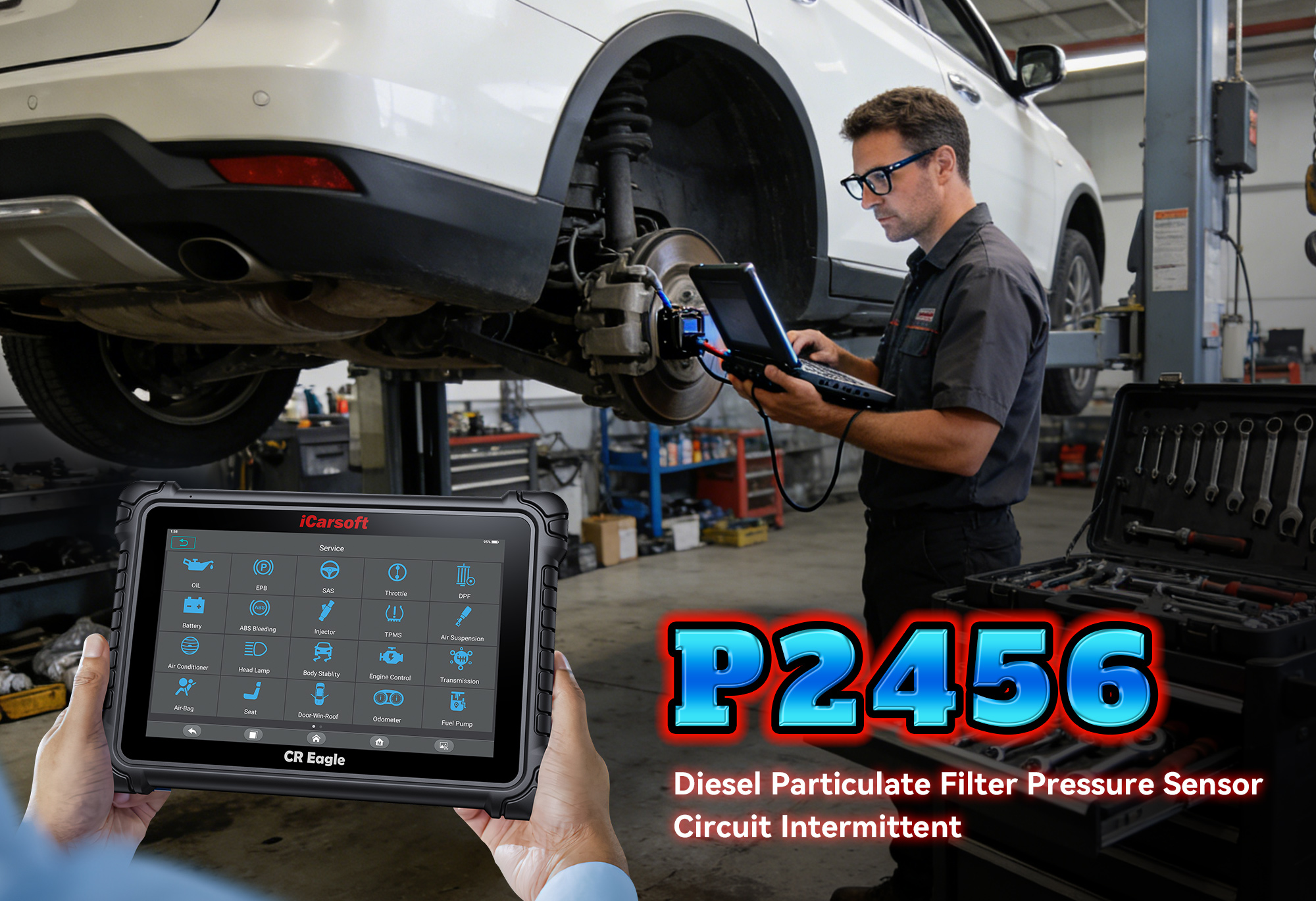
The official definition of P2456 is: “Diesel Particulate Filter (DPF) Pressure Sensor ‘A’ Circuit Low Input”. Let’s decode this for clarity:
-
DPF Pressure Sensor ‘A’: The primary sensor that measures the pressure difference across your DPF. This data tells your vehicle’s Engine Control Module (ECU) how much soot has accumulated, triggering regeneration (the process that burns off soot) when needed.
-
Circuit Low Input: The ECU is receiving a voltage signal from the sensor that’s below the normal operating range (typically 0.5–4.5V). This means the sensor, wiring, or related components aren’t sending valid data—preventing the ECU from managing the DPF effectively.
P2456 is almost exclusive to diesel vehicles (e.g., Ford F-250, Chevrolet Silverado, BMW 335d, Mercedes-Benz Sprinter) but may appear in hybrid or gasoline-direct-injection (GDI) vehicles with similar emissions setups. It’s often linked to other DPF codes like P2454, P2455, or P2457—so addressing it early can prevent a cascade of issues.
Common Symptoms of P2456 You Can’t Miss
P2456 rarely flies under the radar—most drivers notice these red flags within days of the code triggering:
-
Check Engine Light (MIL): The most obvious sign—solid or flashing (flashing means severe damage risk, stop driving immediately).
-
Reduced Engine Power: The ECU activates “limp mode” to protect the DPF, limiting speed to 40–50 mph.
-
DPF Regeneration Failures: Your vehicle can’t complete regeneration, leading to excessive soot buildup.
-
Increased Fuel Consumption: Poor DPF efficiency wastes fuel, dropping MPG by 10–20%.
-
Rough Idle or Misfires: Incorrect pressure readings throw off fuel injection timing.
-
Failed Emissions Tests: A faulty DPF circuit guarantees a failed smog check.
-
Strange Exhaust Smells: Unburned soot or fuel produces a thick, unpleasant odor.
“I ignored P2456 for a week, and my F-250 went into limp mode on the highway—scary stuff! The CR Eagle helped me find the clogged pressure hose in 10 minutes.” — Mike T., Texas (2018 Ford F-250 Owner)
Why Does P2456 Happen? Top 6 Causes
To fix P2456, you need to target the root cause. Here are the most common triggers, ordered by frequency:
1. Clogged DPF Pressure Hoses/Tubes
Small hoses connecting the sensor to exhaust get clogged with soot/carbon/debris, blocking pressure signals and causing low voltage to the ECU.
“My Mercedes Sprinter kept throwing P2456. The CR Eagle’s live data showed no pressure difference—turned out the pressure tube was packed with soot. Cleaned it, and the code was gone!” — Sarah L., California (2020 Mercedes-Benz Sprinter Owner)
2. Faulty DPF Pressure Sensor
High temps/exhaust gases wear out the sensor over time, leading to no signal or consistently low voltage—triggering P2456.
3. Damaged or Corroded Wiring/Connectors
Wiring near engine/exhaust frays, short-circuits, or corrodes; loose connectors disrupt signal flow to the ECU.
4. DPF Clogging
Excessive soot buildup (short trips/low load/failed regeneration) blocks the DPF, causing abnormal pressure readings and low input signals.
5. Exhaust Leaks
Leaks near DPF/sensor let ambient air enter, leading to misread pressure and low voltage signals to the ECU.
6. Faulty Engine Control Module (ECU)
Rare cause—defective ECU fails to process sensor signals correctly (ECUs are highly durable, so rule out other causes first).
Why the iCarsoft CR Eagle Is the Best Tool for P2456
Diagnosing P2456 requires more than a basic OBD2 scanner—it needs a tool that can monitor live DPF data, test sensors, and trigger regeneration. The iCarsoft CR Eagle checks all these boxes and more, making it the top choice for diesel owners:
1. Detailed Code Reading & Interpretation
Displays P2456 with full description, potential causes, and related codes—eliminates guesswork and focuses on the right fix.
2. Live Data Monitoring for DPF Systems
Track sensor voltage, DPF pressure difference, and exhaust temp to spot clogs/leaks/faulty sensors instantly.
“The live data feature was a game-changer. I saw the sensor voltage stuck at 0.2V—knew right away it was a faulty sensor, not a hose issue.” — David R., Florida (2019 Chevrolet Silverado Diesel Owner)
3. Bi-Directional Control (Active Testing)
Send commands to DPF sensor/ECU to test functionality; trigger manual regeneration (if supported) to clear soot—no long highway drives needed.
4. Freeze Frame Data
Capture vehicle conditions (speed, RPM, temp) when P2456 triggered to recreate the scenario and pinpoint the cause.
5. Multi-Brand Compatibility
Works with 100+ brands (Ford, Chevrolet, BMW, Mercedes-Benz, VW, Toyota) for most diesel cars/trucks/SUVs.
6. Lifetime Free Wi-Fi Updates
Stay current with new DTC definitions/vehicle models—no hidden fees, evolves with your fleet.
7. User-Friendly Design
5-inch touchscreen, intuitive menus, step-by-step prompts—no mechanical experience required, plug-and-go!
Ready to tackle P2456? Grab the iCarsoft CR Eagle today and fix your diesel vehicle like a pro.
Step-by-Step Guide to Fixing P2456 with the CR Eagle
Follow these steps to diagnose and resolve P2456 in under an hour (most cases):
Step 1: Connect the CR Eagle to Your Vehicle
Locate the OBDII port (under the driver’s dashboard). Plug in the CR Eagle and turn on the ignition (no need to start the engine). The tool auto-connects to your ECU—no pairing required.
Step 2: Read Codes & Freeze Frame Data
Select “Diagnostics” > “Engine” > “Read DTCs” to retrieve P2456. Check “Freeze Frame” to see when the code triggered (e.g., short trip, high load).
Step 3: Clear the Code & Test-Drive
Select “Clear DTCs” and take a 10-minute test-drive. Re-scan—if P2456 reappears, it’s a genuine issue; if not, it was a temporary glitch.
Step 4: Monitor Live Data
Select “Live Data” > “Engine” > “DPF Pressure Sensor.” Look for:
-
Voltage below 0.5V (indicates low input).
-
No pressure difference when accelerating (signals a clogged hose).
Step 5: Perform Bi-Directional Testing
Select “Bi-Directional Control” > “DPF Pressure Sensor Test.” If the sensor doesn’t respond, it’s faulty—replace it. If it responds but pressure is low, inspect hoses.
Step 6: Inspect Hoses, Wiring, and Connectors
Locate the DPF pressure sensor (on the exhaust manifold/DPF housing). Clean clogged hoses with compressed air; repair frayed wiring. Clean corroded connectors with electrical contact cleaner.
Step 7: Replace the Sensor (if needed)
Swap the faulty sensor with an OEM or high-quality aftermarket part. Use the CR Eagle to clear codes and reset the ECU.
Step 8: Verify the Fix
Take a 30-minute test-drive (include highway driving). Re-scan—if no codes appear, you’re good to go!
“Followed the steps with my CR Eagle and fixed P2456 in 45 minutes. Saved $300 on mechanic fees—this tool pays for itself!” — Jennifer M., Oregon (2017 BMW 335d Owner)
8 FAQs About OBD2 Code P2456 & the iCarsoft CR Eagle
1. Can I drive with P2456?
Short trips (to the auto parts store) are safe, but prolonged driving causes DPF clogging. If the check engine light flashes, stop driving immediately.
2. How much does it cost to fix P2456?
-
Clogged hoses: $30–$100 (DIY).
-
DPF pressure sensor: $60–$200 (part) + $50–$150 (labor).
-
DPF replacement: $500–$2,000 (if ignored).
The CR Eagle saves $80–$150 in diagnostic fees alone.
3. Do I need mechanical skills to use the CR Eagle?
No! The tool’s intuitive design guides you through every step—perfect for DIYers.
4. Will the CR Eagle work with my diesel vehicle?
Yes! It supports over 100 brands and OBDII/EOBD/CAN/CAN-FD protocols. Check the product page for model-specific compatibility.
5. Can the CR Eagle trigger DPF regeneration?
Yes—many diesel vehicles support manual regeneration via the CR Eagle, ideal for short-trip drivers.
6. How often should I update the CR Eagle?
Every 3–6 months for new vehicle compatibility and DTC definitions. Updates are free via Wi-Fi.
7. What if P2456 returns after fixing it?
You may have missed a clogged DPF or damaged wiring. Use the CR Eagle’s live data to re-diagnose.
8. Is the CR Eagle worth the investment?
Absolutely! For diesel owners, it pays for itself after 1–2 uses. It handles all DPF codes, not just P2456.
Preventing P2456: Pro Maintenance Tips
-
Take monthly highway trips: Drive 50+ mph for 20+ minutes to trigger natural regeneration.
-
Use high-quality diesel fuel: Reduces soot production and sensor damage.
-
Change engine oil on time: Use DPF-compatible oil to avoid ash buildup.
-
Scan with the CR Eagle quarterly: Catch intermittent issues before they become codes.
Final Thoughts
OBD2 code P2456 doesn’t have to be a nightmare—with the iCarsoft CR Eagle, you can diagnose and fix it yourself, saving time, money, and frustration. This tool is a must-have for diesel vehicle owners who want to avoid costly mechanic visits and keep their emissions systems in top shape.
Don’t let P2456 ruin your drive (or your budget). Grab the iCarsoft CR Eagle today and take control of your vehicle’s maintenance.
Have questions about P2456 or the CR Eagle? Drop a comment below—we’re here to help!
Customer Reviews Snippet:
“Fixed my P2456 in 30 minutes—CR Eagle is worth every penny!” — Thomas B., Arizona
“As a fleet manager, the CR Eagle has saved me thousands on DPF repairs. Highly recommend!” — Lisa K., Illinois
“No more guessing—live data showed exactly what was wrong with my sensor. 10/10!” — Mark S., New York
Disclaimer: This guide is for informational purposes only. Always consult your vehicle’s owner’s manual or a certified mechanic before major repairs. iCarsoft is not responsible for damage from improper tool use.