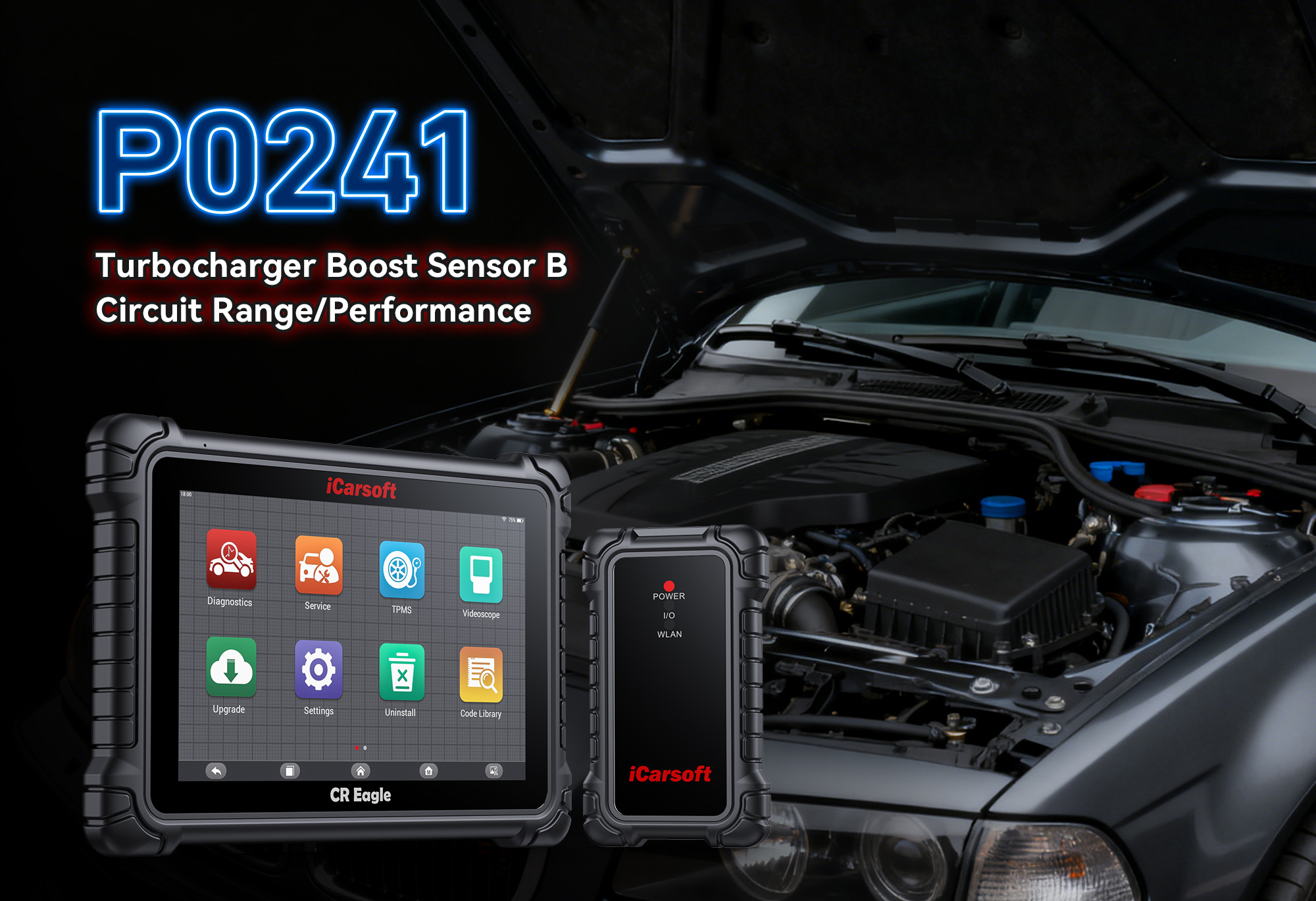
Fix P0241: Turbocharger Wastegate Solenoid Circuit Issue – 2024 DIY Guide with iCarsoft CR Eagle
If your turbocharged vehicle’s check engine light illuminates and scans to OBD2 code P0241, you’re staring down a turbo system problem that demands attention. Left unaddressed, P0241 leads to reduced turbo boost, sluggish acceleration, poor fuel efficiency, and even turbocharger damage—costing thousands in repairs. But here’s the relief: with the right diagnostic tool and step-by-step know-how, you can pinpoint the root cause, fix it yourself, and skip expensive mechanic bills.
In this ultimate guide, we’ll break down P0241 in plain language—what it means, common symptoms, top causes, and how the iCarsoft CR Eagle diagnostic tool makes resolving it a breeze for DIYers and pros. We’ll also share real customer reviews, answer 8 critical FAQs, and highlight why the CR Eagle is the #1 choice for tackling turbo-related codes.
What Is OBD2 Code P0241, Exactly?
OBD2 (On-Board Diagnostics II) codes are standardized across all modern vehicles (1996+ in the U.S., 2001+ in the EU) to communicate system faults. P0241 falls under the “powertrain” category, targeting the turbocharger system—a critical component for boosted engines (gasoline and diesel alike).
The official definition of P0241 is: “Turbocharger/Supercharger Wastegate Solenoid ‘A’ Circuit Range/Performance”. Let’s decode this for clarity:
-
Wastegate Solenoid: Regulates the turbocharger’s wastegate (a valve that controls exhaust gas flow to the turbo). It adjusts boost pressure by opening/closing the wastegate, preventing overboost or underboost.
-
Circuit Range/Performance: The Engine Control Module (ECU) receives a signal from the solenoid that falls outside the normal operating range. This means the solenoid, wiring, vacuum lines, or ECU isn’t functioning correctly—disrupting turbo boost control.
P0241 is common in turbocharged vehicles from brands like Ford (F-150 EcoBoost), Volkswagen (Golf GTI), BMW (335i), Audi (A4), and Chevrolet (Silverado Duramax). It often pairs with other turbo codes (e.g., P0234, P0299, P0242) — so addressing it early stops small issues from becoming catastrophic.
Common Symptoms of P0241 You Can’t Miss
P0241 triggers noticeable turbo-related red flags within days of the code appearing:
-
Check Engine Light (MIL): Solid or flashing (flashing = severe turbo strain; stop driving immediately).
-
Reduced Turbo Boost/Acceleration: The engine feels “flat” — no power during overtaking or uphill drives.
-
Turbo Lag: Delayed response when pressing the gas pedal.
-
Increased Fuel Consumption: Poor turbo efficiency forces the engine to burn more fuel (15–25% lower MPG).
-
Engine Knocking/Pinging: Underboost or overboost disrupts combustion.
-
Solenoid Clicking Noises: A faulty solenoid may make constant or intermittent clicking sounds when the engine is running.
“My 2020 Ford F-150 EcoBoost lost all boost and threw P0241. I thought I needed a new turbo—until the CR Eagle showed it was a faulty wastegate solenoid. Fixed it for $75!” — Ryan T., Texas (2020 Ford F-150 Owner)
Why Does P0241 Happen? Top 6 Causes
To fix P0241, target the root cause. Here are the most common triggers, ordered by frequency:
1. Faulty Turbocharger Wastegate Solenoid
Solenoid wears out over time (heat/vibration/electrical damage); faulty solenoid fails to open/close properly, sending erratic signals to ECU—triggering P0241.
“My Volkswagen Golf GTI kept throwing P0241. The CR Eagle’s bi-directional test showed the solenoid didn’t respond—replaced it, and the boost came back instantly!” — Mia L., California (2018 Volkswagen Golf GTI Owner)
2. Damaged or Corroded Wiring/Connectors
Wiring between wastegate solenoid/ECU exposed to engine heat/vibration/road debris; frayed wires/short circuits/corroded connectors disrupt signal flow.
3. Clogged or Leaking Vacuum Lines
Wastegate solenoid relies on vacuum lines to control wastegate; dirt/oil/debris clogs lines, or cracks/leaks cause pressure loss—preventing proper solenoid operation.
“I ignored P0241 for weeks, and my BMW 335i’s vacuum lines were cracked and clogged with oil. Replaced the lines and used the CR Eagle to clear the code—boost is back to normal!” — Jake R., Florida (2017 BMW 335i Owner)
4. Stuck or Damaged Wastegate
Carbon deposits/mechanical wear cause wastegate to stick open/closed; forces solenoid to work harder, leading to circuit range issues.
5. Faulty Engine Control Module (ECU)
Rare cause—defective ECU misinterprets solenoid signal, falsely triggering P0241 (most cases are solenoid/wiring related).
6. Low Battery Voltage
Weak battery power disrupts solenoid’s electrical circuit, causing intermittent P0241 codes (common in older vehicles).
Why the iCarsoft CR Eagle Is the Best Tool for P0241
Diagnosing P0241 requires more than a basic OBD2 scanner—it needs a tool that can communicate with the turbo system, test the wastegate solenoid, and monitor boost pressure. The iCarsoft CR Eagle delivers all this and more:
1. Turbo-Specific Code Reading & Interpretation
Displays P0241 with detailed descriptions, potential causes, and related codes (solenoid failure/vacuum leak)—no guesswork!
2. Live Data Monitoring for Turbo Systems
Track wastegate solenoid voltage, turbo boost pressure, ECU signal output to spot range/performance issues instantly.
“The live data feature saved me. I saw the solenoid voltage was fluctuating wildly—knew right away it was a wiring issue, not a faulty solenoid. Saved $150 on unnecessary parts!” — Chloe M., Oregon (2019 Audi A4 Owner)
3. Bi-Directional Control (Active Testing)
Send commands to wastegate solenoid to test functionality; verify if solenoid opens/closes or issue is wiring/ECU.
4. Boost Pressure Validation
Monitor turbo boost pressure in real time to confirm if underboost/overboost is linked to solenoid or wastegate.
5. Multi-Brand & Multi-System Compatibility
Works with 100+ brands (Ford/VW/BMW/Audi/Chevrolet) and covers engine/ABS/airbag/transmission—perfect for turbocharged cars/trucks/SUVs.
6. Lifetime Free Wi-Fi Updates
Stay current with new turbo system definitions/vehicle models—no hidden fees, grows with your vehicle.
7. User-Friendly Design
5-inch touchscreen, intuitive menus, step-by-step prompts—no mechanical experience required, plug-and-go!
Ready to fix P0241 like a pro? Grab the iCarsoft CR Eagle today and avoid costly turbo repairs.
Step-by-Step Guide to Fixing P0241 with the CR Eagle
Follow these steps to diagnose and resolve P0241 in under an hour (most cases):
Step 1: Connect the CR Eagle to Your Vehicle
Locate the OBDII port (under the driver’s dashboard). Plug in the CR Eagle and turn on the ignition (no need to start the engine). The tool auto-connects to your ECU—no pairing required.
Step 2: Read Codes & Freeze Frame Data
Select “Diagnostics” > “Engine” > “Read DTCs” to retrieve P0241. Check “Freeze Frame” to see when the code triggered (e.g., high engine load, cold start).
Step 3: Clear the Code & Test-Drive
Select “Clear DTCs” and take a 15-minute test-drive (focus on acceleration to engage turbo). Re-scan—if P0241 reappears, it’s a genuine issue; if not, it was a temporary glitch.
Step 4: Monitor Live Data
Select “Live Data” > “Engine” > “Turbo/Wastegate.” Look for:
-
Solenoid voltage outside the normal range (typically 10–14V when activated).
-
Boost pressure below/above vehicle specs (check owner’s manual).
Step 5: Perform Bi-Directional Testing
Select “Bi-Directional Control” > “Wastegate Solenoid Test.” Activate the solenoid—listen for a clicking sound (indicates it’s working). If no click, the solenoid is faulty. If the solenoid clicks but boost is abnormal, inspect vacuum lines/wastegate.
Step 6: Inspect Wiring, Connectors, and Vacuum Lines
Locate the wastegate solenoid (usually near the turbocharger or engine bay). Inspect wiring for fraying; clean corroded connectors with electrical contact cleaner. Check vacuum lines for cracks, leaks, or clogs—replace or repair as needed.
Step 7: Replace Faulty Components (if needed)
Swap the faulty wastegate solenoid with an OEM or high-quality aftermarket part. Replace stuck/damaged wastegate components if bi-directional testing confirms the issue.
Step 8: Verify the Fix
Take a 30-minute test-drive (include highway acceleration to test turbo boost). Re-scan with the CR Eagle—if no codes appear, you’re done!
“Followed the steps and fixed P0241 in 45 minutes. The CR Eagle walked me through every part—total beginner here! Saved $800 on turbo repair fees.” — Tyler K., Arizona (2016 Chevrolet Silverado Duramax Owner)
8 FAQs About OBD2 Code P0241 & the iCarsoft CR Eagle
1. Can I drive with P0241?
Short trips (to the auto parts store) are safe, but prolonged driving causes turbo damage. If the check engine light flashes or you hear turbo noise, stop driving immediately.
2. How much does it cost to fix P0241?
-
Wastegate solenoid: $50–$200 (DIY).
-
Vacuum lines: $20–$80 (DIY).
-
Wiring/connector repairs: $50–$150.
-
Turbocharger replacement: $1,500–$3,000 (if ignored).
The CR Eagle saves $80–$150 in diagnostic fees alone.
3. Do I need mechanical skills to use the CR Eagle?
No! The tool’s step-by-step prompts guide you through every step—perfect for DIYers with zero experience.
4. Will the CR Eagle work with my turbocharged vehicle?
Yes! It supports over 100 brands, including turbocharged models from Ford, VW, BMW, Audi, Chevrolet, and Mercedes-Benz. Check the product page for model-specific compatibility.
5. Can the CR Eagle test the wastegate directly?
Yes—its bi-directional control lets you activate the wastegate solenoid and monitor boost pressure to confirm wastegate functionality.
6. How often should I update the CR Eagle?
Every 3–6 months for new vehicle compatibility and DTC definitions. Updates are free via Wi-Fi—no computer required.
7. What if P0241 returns after fixing it?
You may have missed a clogged vacuum line or damaged wastegate. Use the CR Eagle’s live data to re-diagnose the turbo system.
8. Is the CR Eagle worth the investment for P0241?
Absolutely! It pays for itself after 1–2 uses. Plus, it handles all turbo and powertrain codes, not just P0241—making it a long-term tool for boosted vehicle owners.
Preventing P0241: Pro Maintenance Tips
-
Change engine oil on schedule: Clean oil reduces turbo/solenoid wear (critical for turbocharged engines).
-
Inspect vacuum lines quarterly: Check for cracks, leaks, or clogs—replace aging lines.
-
Use high-quality fuel: Poor fuel causes carbon buildup in the wastegate and solenoid.
-
Scan with the CR Eagle every 6 months: Catch intermittent turbo issues before they trigger P0241.
Final Thoughts
OBD2 code P0241 doesn’t have to mean costly turbocharger repairs—with the iCarsoft CR Eagle, you can diagnose and fix the root cause yourself. This tool empowers DIYers to save time, money, and frustration while keeping their turbocharged vehicle’s performance in top shape.
Don’t let P0241 kill your turbo’s boost. Grab the iCarsoft CR Eagle today and take control of your vehicle’s turbo health.
Have questions about P0241 or the CR Eagle? Drop a comment below—we’re here to help!
Customer Reviews Snippet:
“P0241 had me terrified of turbo replacement—CR Eagle showed it was a $60 solenoid. 10/10 recommend!” — Olivia M., Illinois
“As a turbo car enthusiast, the CR Eagle is my go-to tool. Fixed P0241 and saved thousands!” — Noah S., New York
“Zero mechanical experience—CR Eagle walked me through fixing P0241 in an hour. Worth every penny!” — Emma K., Georgia
Disclaimer: This guide is for informational purposes only. Always consult your vehicle’s owner’s manual or a certified mechanic before major repairs. iCarsoft is not responsible for damage from improper tool use.