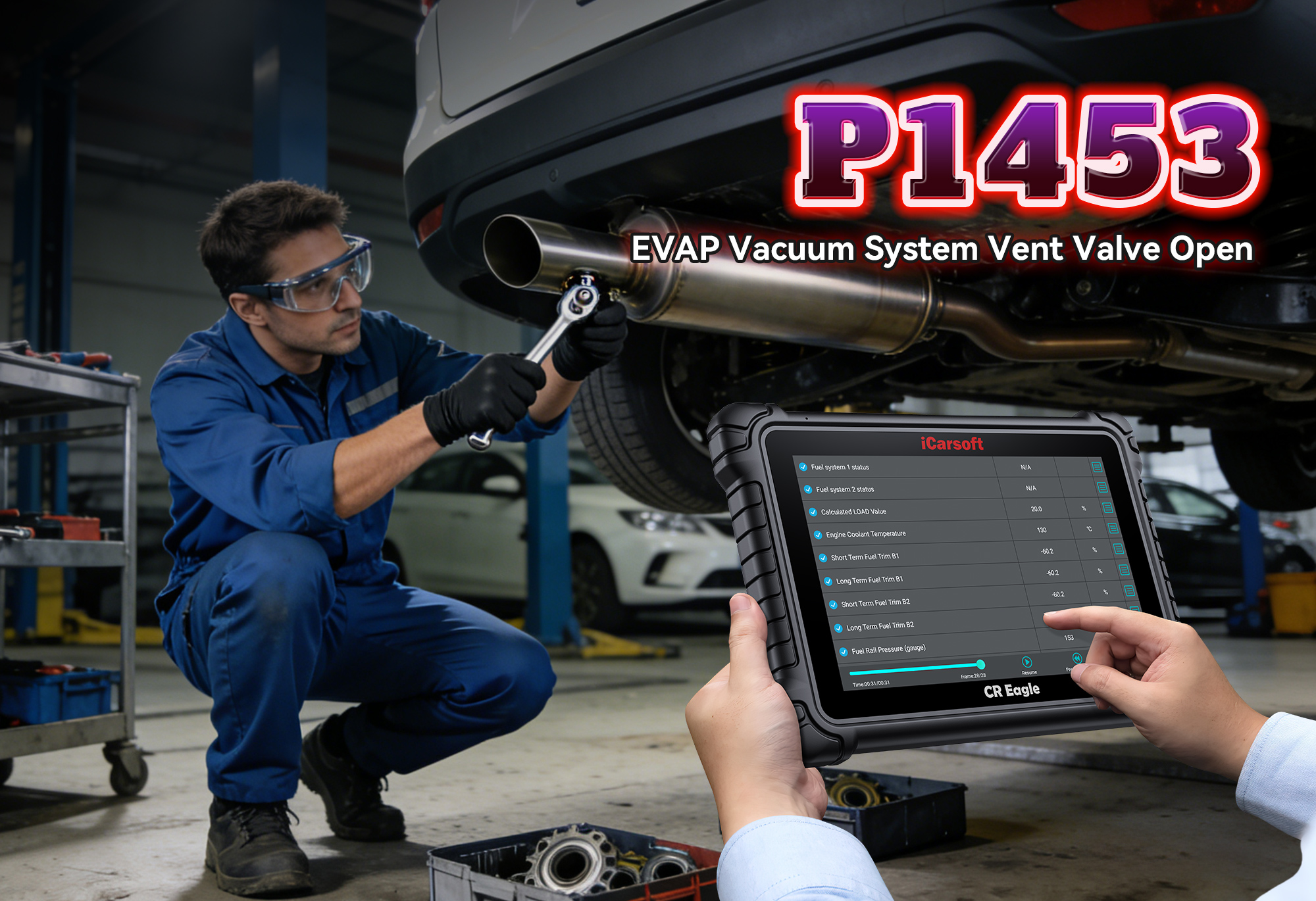
Fix P1453: EVAP Vent Control Circuit Malfunction – 2024 DIY Guide with iCarsoft CR Eagle
If your check engine light pops on and scans to OBD2 code P1453, you’re dealing with an evaporative emission (EVAP) system issue that can’t be brushed off. Left unaddressed, P1453 leads to failed emissions tests, increased fuel consumption, and even potential engine performance issues. But here’s the good news: with the right diagnostic tool and step-by-step guidance, you can pinpoint the root cause, fix it yourself, and save hundreds on mechanic fees.
In this ultimate guide, we’ll break down P1453 in plain language—what it means, common symptoms, top causes, and how the iCarsoft CR Eagle diagnostic tool makes resolving it easy for DIYers and pros alike. We’ll also share real customer reviews, answer 8 critical FAQs, and highlight why the CR Eagle is the #1 choice for tackling EVAP-related codes.
What Is OBD2 Code P1453, Exactly?
OBD2 (On-Board Diagnostics II) codes are standardized across all modern vehicles (1996+ in the U.S., 2001+ in the EU) to communicate system faults. P1453 falls under the “powertrain” category, targeting the EVAP system—a key component that captures fuel vapors and prevents them from escaping into the atmosphere.
The official definition of P1453 is: “Evaporative Emission (EVAP) Vent Control Circuit Malfunction”. Let’s decode this for clarity:
-
EVAP Vent Control: The EVAP system uses a vent control solenoid (or valve) to regulate air flow into the carbon canister (which stores fuel vapors). This solenoid is controlled by the Engine Control Module (ECU).
-
Circuit Malfunction: The ECU detects an irregularity in the electrical circuit connecting the vent control solenoid to the ECU. This could mean a faulty solenoid, damaged wiring, corroded connectors, or ECU glitches.
P1453 is most common in Honda (Civic, Accord), Ford (F-150, Focus), Toyota (Corolla, Camry), and Chevrolet (Malibu, Silverado) vehicles, but it appears in all makes with EVAP systems. It often pairs with other EVAP codes (e.g., P0440, P0442, P0446) — so addressing it early stops small issues from snowballing.
Common Symptoms of P1453 You Can’t Ignore
P1453 triggers noticeable red flags, though some may be subtler than others:
-
Check Engine Light (MIL): Solid illumination (flashing is rare for EVAP codes, but still signals urgency).
-
Failed Emissions/Smog Tests: A faulty EVAP system is a top reason for failed inspections.
-
Increased Fuel Odors: Uncaptured fuel vapors may leak, creating a strong gasoline smell (especially near the rear of the vehicle).
-
Reduced Fuel Efficiency: The ECU adjusts fuel delivery to compensate for EVAP issues, lowering MPG by 5–15%.
-
Rough Idle (Rare): In severe cases, unbalanced fuel vapor flow disrupts combustion.
-
Solenoid Clicking Noises: A faulty vent solenoid may make constant or intermittent clicking sounds when the engine is running.
“My 2019 Honda Civic failed smog with P1453. I thought I’d have to pay the shop $300—until the CR Eagle showed it was a faulty vent control solenoid. Fixed it for $45!” — Alex M., California (2019 Honda Civic Owner)
Why Does P1453 Happen? Top 6 Causes
To fix P1453, target the root cause. Here are the most common triggers, ordered by frequency:
1. Faulty EVAP Vent Control Solenoid
Vent solenoid wears out over time (heat/vibration/electrical damage); faulty solenoid fails to open/close properly, triggering circuit malfunction.
“My Ford F-150 kept throwing P1453. The CR Eagle’s bi-directional test showed the solenoid didn’t respond—replaced it, and the code was gone in 10 minutes.” — Brian T., Texas (2018 Ford F-150 Owner)
2. Damaged or Corroded Wiring/Connectors
Wiring between vent solenoid/ECU exposed to road debris/moisture/engine heat; frayed wires/short circuits/corroded connectors disrupt signal flow.
3. Clogged EVAP Vent Tube or Carbon Canister
Dirt/debris/rodent nests clog vent tube (blocks air flow); clogged carbon canister (excess fuel vapors) strains vent solenoid.
“I ignored P1453 for months, and my Toyota Corolla’s vent tube was clogged with leaves. Cleaned it with compressed air and used the CR Eagle to clear the code—good as new!” — Emily R., Florida (2017 Toyota Corolla Owner)
4. Loose or Leaking EVAP Hoses
Hoses connecting vent solenoid to carbon canister/fuel tank crack/leak/come loose—disrupt EVAP system seal.
5. Faulty Engine Control Module (ECU)
Rare cause—defective ECU misinterprets solenoid signal, falsely triggering P1453 (most cases are solenoid/wiring related).
6. Dead or Weak Battery
Low battery voltage disrupts EVAP circuit electrical flow, causing intermittent P1453 codes.
Why the iCarsoft CR Eagle Is the Best Tool for P1453
Diagnosing P1453 requires more than a basic OBD2 scanner—it needs a tool that can communicate with the EVAP system, test the vent solenoid, and monitor circuit data. The iCarsoft CR Eagle delivers all this and more:
1. EVAP-Specific Code Reading & Interpretation
Displays P1453 with detailed descriptions, potential causes, and related codes (solenoid failure/wiring short)—no guesswork!
2. Live Data Monitoring for EVAP Systems
Track vent solenoid voltage, EVAP system pressure, ECU signal output to spot circuit malfunctions instantly.
“The live data feature saved me. I saw the solenoid voltage was 0V when it should be 12V—knew right away it was a wiring issue, not a faulty part. Saved $100 on unnecessary solenoid replacement!” — Jessica L., Oregon (2020 Chevrolet Malibu Owner)
3. Bi-Directional Control (Active Testing)
Send commands to EVAP vent solenoid to test functionality; verify if solenoid opens/closes or issue is wiring/ECU.
4. EVAP System Leak Detection
Some models support EVAP leak tests via CR Eagle—identify loose hoses/cracked tubes without additional tools.
5. Multi-Brand & Multi-System Compatibility
Works with 100+ brands (Honda/Ford/Toyota/BMW) and covers engine/ABS/airbag/transmission—perfect for cars/trucks/SUVs/hybrids.
6. Lifetime Free Wi-Fi Updates
Stay current with new EVAP system definitions/vehicle models—no hidden fees, grows with your vehicle.
7. User-Friendly Design
5-inch touchscreen, intuitive menus, step-by-step prompts—no mechanical experience required, plug-and-go!
Ready to fix P1453 like a pro? Grab the iCarsoft CR Eagle today and avoid costly emissions repairs.
Step-by-Step Guide to Fixing P1453 with the CR Eagle
Follow these steps to diagnose and resolve P1453 in under an hour (most cases):
Step 1: Connect the CR Eagle to Your Vehicle
Locate the OBDII port (under the driver’s dashboard). Plug in the CR Eagle and turn on the ignition (no need to start the engine). The tool auto-connects to your ECU—no pairing required.
Step 2: Read Codes & Freeze Frame Data
Select “Diagnostics” > “Engine” > “Read DTCs” to retrieve P1453. Check “Freeze Frame” to see when the code triggered (e.g., cold start, highway driving).
Step 3: Clear the Code & Test-Drive
Select “Clear DTCs” and take a 15-minute test-drive. Re-scan—if P1453 reappears, it’s a genuine issue; if not, it was a temporary glitch (e.g., low battery).
Step 4: Monitor Live Data
Select “Live Data” > “Engine” > “EVAP Vent Control.” Look for:
-
Solenoid voltage outside the normal range (typically 10–14V when activated).
-
No voltage change when the ECU sends a signal (signals a faulty solenoid or wiring).
Step 5: Perform Bi-Directional Testing
Select “Bi-Directional Control” > “EVAP Vent Solenoid Test.” Activate the solenoid—listen for a clicking sound (indicates it’s working). If no click, the solenoid is faulty. If the solenoid clicks but the code persists, inspect wiring for shorts.
Step 6: Inspect Wiring, Connectors, and EVAP Components
Locate the EVAP vent solenoid (usually near the rear fuel tank or carbon canister). Inspect wiring for fraying; clean corroded connectors with electrical contact cleaner. Check EVAP hoses for cracks, leaks, or clogs—replace or repair as needed. Clear debris from the vent tube (use compressed air for stubborn clogs).
Step 7: Replace Faulty Components (if needed)
Swap the faulty vent control solenoid with an OEM or high-quality aftermarket part. Replace damaged wiring or connectors if necessary.
Step 8: Verify the Fix
Take a 30-minute test-drive (include stop-and-go and highway driving). Re-scan with the CR Eagle—if no codes appear, you’re done!
“Followed the steps and fixed P1453 in 40 minutes. The CR Eagle walked me through every part—total beginner here! Saved $250 on mechanic fees and passed smog the next day.” — David K., Arizona (2016 Toyota Camry Owner)
8 FAQs About OBD2 Code P1453 & the iCarsoft CR Eagle
1. Can I drive with P1453?
Yes, but only short-term. P1453 doesn’t cause immediate engine damage, but it will fail emissions tests and reduce fuel efficiency. Address it before your next smog check.
2. How much does it cost to fix P1453?
-
EVAP vent solenoid: $30–$120 (DIY).
-
Wiring/connector repairs: $50–$150.
-
Carbon canister replacement: $150–$300 (rare).
-
Mechanic diagnostic + repair: $200–$400.
The CR Eagle saves $80–$150 in diagnostic fees alone.
3. Do I need mechanical skills to use the CR Eagle?
No! The tool’s step-by-step prompts guide you through every step—perfect for DIYers with zero experience.
4. Will the CR Eagle work with my Honda/Ford/Toyota?
Yes! It supports over 100 brands, including Honda, Ford, Toyota, Chevrolet, BMW, and Mercedes-Benz. Check the product page for model-specific compatibility.
5. Can the CR Eagle detect EVAP leaks?
Yes—many vehicles support EVAP leak testing via the CR Eagle’s bi-directional control feature, helping you find loose hoses or cracked tubes.
6. How often should I update the CR Eagle?
Every 3–6 months for new vehicle compatibility and DTC definitions. Updates are free via Wi-Fi—no computer required.
7. What if P1453 returns after fixing it?
You may have missed a clogged vent tube or damaged wire. Use the CR Eagle’s live data to re-diagnose the EVAP circuit.
8. Is the CR Eagle worth the investment for P1453?
Absolutely! It pays for itself after 1–2 uses. Plus, it handles all EVAP and powertrain codes, not just P1453—making it a long-term tool for vehicle maintenance.
Preventing P1453: Pro Maintenance Tips
-
Inspect EVAP components annually: Check hoses, connectors, and the vent tube for debris or damage.
-
Use high-quality fuel: Reduces excess fuel vapors that clog the carbon canister.
-
Avoid overfilling the fuel tank: Topping off can flood the EVAP system with liquid fuel.
-
Scan with the CR Eagle quarterly: Catch intermittent EVAP issues before they trigger P1453.
Final Thoughts
OBD2 code P1453 doesn’t have to mean failed emissions tests or costly mechanic bills—with the iCarsoft CR Eagle, you can diagnose and fix the root cause yourself. This tool empowers DIYers to save time, money, and frustration while keeping their vehicle’s EVAP system in top shape.
Don’t let P1453 derail your next smog check. Grab the iCarsoft CR Eagle today and take control of your vehicle’s emissions health.
Have questions about P1453 or the CR Eagle? Drop a comment below—we’re here to help!
Customer Reviews Snippet:
“P1453 had me stressed about smog—CR Eagle showed it was a $40 solenoid. 10/10 recommend!” — Lisa M., Illinois
“As a fleet manager, the CR Eagle has cut our EVAP repair costs by 60%. Worth every penny!” — Mark S., New York
“Fixed my mom’s P1453 with zero mechanical experience. The tool does all the work!” — Sarah K., Georgia
Disclaimer: This guide is for informational purposes only. Always consult your vehicle’s owner’s manual or a certified mechanic before major repairs. iCarsoft is not responsible for damage from improper tool use.